
The Lures and fishing Techniques
Published · Updated
This story has been restored from the magazine archive. The text is original; outdated contact details have been removed.

WHERE DO THE PERCH LURK?
In the following illustration there is a general outlook on the places where you can find the stripeshirts. Perch have to move into deeper water when the air pressure drops because of their closed swim bladder. When there´s high pressure the perch swim towards shallower waters. 1) You find the perch in the bottom plant zone and the small holes in it at the time of the first ice formation. Especially in ponds the perch like to hide in the shade of fallen trees. The mouths of rivers and streams are places where perch feed all winter. When the surface has just frozen and during late spring the icefisher should approach these current places with utter caution. 2) At sea, in front of the rushes you often find a zone of bladder wrack where the forage animals of perch hide themselves. In all water way types when fishing in the weed zone, you have to be prepared to encounter pike that cut your lines. The shore ledges are the morning and evening feeding places of perch. 3) At the side of the precipitous steep you find the perch all day long. You just have to find the right striking depth first. 4) In a rather deep area (3 to 8 metres) with uneven bottom structure the perch also feed during the whole day. 5) In the basins of waterways there are in most cases no fish but the giant perch like to dwell in the slopes of the basins. 6) Underwater hills and ridges are the wintering places for perch at wider open sea areas and the sea proper. When feeding in the morning or in the evening the perch swim on the shallowest locations. All during the day the perch feed on the slopes and on the terraces. 7) Rock beds and shallows are "sure to get" perch sites. Morning or evening feeding may take place in water no deeper than a half a metre. The giant perch actually spend their day on the basin side slope of the rock beds.
If the fishing site is new and you are not familiar with the bottom structures you start a systematic search for the striking site. First you drill a row of holes at a couple of metre´s intervals or just a couple of holes coming straight out from the shore. You start fishing from the hole nearest the shore and change holes outwards every few minutes. When you find the perch you can drill a few more holes around the first striking hole.
VERTICAL JIGS
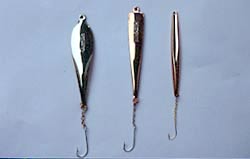
The basic lure of every icefisherman is the vertical jig. The purpose of the jig is to lure the perch near the bait. Every jig swims in it´s own particular way that the angler should learn to utilize. Practise by examining the swimming action of the jig and by learning the right kind of "handwriting" will make even a rookie icefisherman a successful one. It is easy to learn the handwriting of at least four classic types of jigs: Nautilus, Hopeasiipi (the Silver Wing), Valio and the INI. This foursome has been on the list of the ten most selling lures in Finland for several years in a row, so filling the vertical compartment of your jig purse with them is sure to give you value for the money. There are only two problems left in the lure department; what size and which colour? As the basic lure you should choose a middle-sized five to seven centimetre jig. Deciding on the colour combination is a more tricky problem, because the striking colour will vary according to the water and the season. During early winter the colour combinations that work are different from those that work later on in the winter or on the last ice cover of the spring. Any fishing gear salesman who knows his business will be an expert on at least the colour scales of his own region. If you buy your jigs at the fishing department of a supermarket, it is safest to pick the colour combinations there are least left on the shelf i.e. those that have been selling the best.
Fly grubs are the favourite baits at present. They can be bought at all fishing gear shops. The grubs have been fed with meat mixed with different caramel colours to lure the fish with every colour of the rainbow. The best colour to fish is generally reddish. There are situations and especially waterways, where even blue, yellow or green grubs catch perch better than red or natural coloured grubs. The other basic bait is the chironomid grub. Hooking this dark red, thin, wormlike creature is often hard without piercing the bait. Fly grubs are used as basic baits when the perch bite normally. When they are not active you can change a thinner hook and use a fly-chironomid combination as your bait. In most cases though, it is sensible to change your tool when the perch turn choosy. That´s the time to grope your rucksack for the mormuska rod and bait a balanced jig with a mere chironomid grub. Preserving both the grubs is very particular. The baits must not get frozen so they should be kept in, for instance, foamed plastic box safe from the cold. When keeping the grubs at home the right place is the fridge because when kept too warm they tend to pupate. Preserving the grub box in room temperature for a couple of days is enough to give you a swarm of flies when you open the lid.
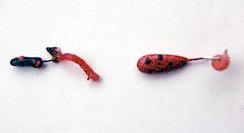
Compost worms and especially red leafworms are still good baits for perch. Unfortunately only few shops sell these baitworms that the perch find sweet-smelling.The icefisherman who has a juicy leaf compost at hand will often have the upper hand in the amount of catch to those fishermen who do not have worms available. You can also bait a vertical with a fisheye. Perch and ruff eyes last well and are easy to take out by pressing with your thumb. The eyes of roach fish tend to break when hooking and do not last long. Before taking the eye out it´s best to knock the fish dead or break his neck, because fishing is not, contrary to the comments of the conservationists, intended to be animal torture. It is also fit to kill the fish quickly when you slice the baitfish for fins or skin to trail the jig. Big perch that normally eat smallfish like baits of fish meat in particular.
The basic technique of vertical jigging is as follows. First you lower the jig down to the bottom. When it reaches the bed the line goes slack. You now raise the jig enough to keep it floating a few centimetres above the bottom. Next you start luring movements using the practised handwriting. The movement should not be repeated monotonously and mechanically though. Small additional vibes and knocking the bottom every now and then will lure the stripeshirts near the bait. When you feel the first bite you reduce the scope of the luring movements. for instance the Nautilus is a jig with a wide movement and luring effect sideways. If the jig swings behind the tails of the perch examining it, the fish will startle and flee. When this happens you will have to start the whole luring process anew. The perch are school fish characterized by envious behaviour. When the first one has struck at the bait and is on his way up by the line elevator towards the hole and the rucksack, at least a part of the school will follow their unfortunate friend inching upwards. After several landings the school might be a foot or two above the bottom. The angler will check the bait quickly after each catch and lower the jig immediately back to the angling depth. When the school is really striking, competition icefishermen often change to a different rod to which they have attached a vertical jig swimming straight down. This way the jig will not swim sideways behind the tails of the fish when lowering and doesn´t scare the school away.
THE CHAIN JIG
The hook of a verticl jig is normally attached below it by a small ring. This is quite allright when the perch are active or biting moderately well. If the perch aren´t active or the schools are scattered, you increase your effectivity if you have the hook hanging by an inch of chain below the jig. Several manufacturers recommend that their jigs should always be used with a chain.
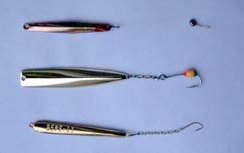
and the snell fitted mormuska.
The effectiveness of the chain jig is based on the envy reaction mentioned earlier. Seen from the perch´s perspective the vertical looks like a small fish aiming at the bait swinging by the chain. Turning green with envy the perch will grab the bait for itself and end up in the icefisherman´s rucksack. The angling technique of the chain jig is very close to normal vertical jigging. Often the total stopping of the jig movement or slow vibrating lifts will trigger the strike.
COLOURED HOOKS
Fishing with coloured hooks has been introduced to Finland from Sweden. They even arrange tournaments where live baits are prohibited there.. The coloured hook is normally attached to a vertical but also balanced jigs are sometimes spiced with them. There are two main types of coloured hooks. The single pin is most often attched to the vertical by a chain, the triple is fastened with a ring. You can also bait the single hook. The effect of the triple hook is based on the the striking point reaction so the triple is generally not baited.
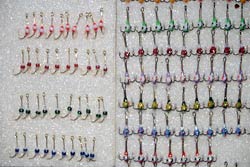
Choosing the colours and their combinations is a rather complicated task, The striking colour varies according to the characteristics of the water way and is furthermore affected by the season, the time of day, lightness or darkness and the weather conditions. The only way to find the right colour is by experimenting. The technique of fishing a single hook is similar to that of the chain jig. The effectiveness of the triple hook pin is based on continual movement with the coloured hook as the irritating striking point. You can use a coloured hook with any vertical. There are also jigs developed specifically for icefishing with coloured hooks.
THE SNELL RIGGED MORMUSKA JIGS
When you rig a vertical with a mormuska, a micro-sized balnced jig, you get a combination catching the hard-to-get and choosy perch. The snell rig has a couple of advantages when compared to using a mere mormuska. The vertical will take the mormuska and the bait quickly down even in deep waters when you have already lured the school there. The wind and ice gathering on the line will be not such big disadvantages when fishing with a snell rig than when you fish with just a mormuska. The snell line has to be somewhat thinner than the main line because the movements of the mormuska at the end of the line should be tempting. The length of the snell may vary from five to twenty centimetres depending on the situation. The most common arrangement is using a 5 cm (2 inch) line between the jig and the mormuska. It´s best to rig the snells at home where your fingers stay warm for making small knots barehanded when it´s freezing cold will stress both your fingers and your nerves. At the upper end of the snell you tie a quick coupling which makes it possible to change the mormuska quickly, if required. The mormuskas you choose to use will naturally be those known to yield in the waters you´re fishing. Fly and chironomid grubs are the best baits. It´s best to keep the prepared snells straight. A foamed plastic or balsa plate is a handy place to keep them attached by pins and the mormuska hooks. When beginning your icefishing you use the vertical jigging technique to lure the school of perch to the site. After you get the first strikes, change into the mormuska fishing technique.
THE MORMUSKAS OR THE MICRO-SIZED BALANCED JIGS
Fishing with coloured hooks has come to Finland from the west, from Sweden. The mormuska technique has been adopted from our eastern neighbouring country, Russia. In the 1960´s and still in the 1970´s the icefishing matches between the Soviet Union and Finland ended up at approximately the same score as the icehockey matches at the time, i.e. 10 - 1. Little by little the Finns also learned the technique of the mormuska fishing, which is quite overwhelming when the perch aren´t active. The mormuska is an excellent lure for perch, the only disadvantage is that the roach fish species also strike at it even too frequently.
Figure 2. The knots
You can tie a holed mormuska to the line with several different kinds of knots. A mere stopper knot is adequate if the fish you catch are smallish, less than a hundred grams in weight. When you expect to get stripeshirts up to a quarter kilogram it´s wisest to tie the mormuska in the shaft of the hook with a secured knot. The unic knot is a good tight knot for this purpose. You can leave the loop a bit open so that the actual knot works as a stopper at the lower end of the hole. When you tie the knot this way you also should, at times, check how much the thin line has worn out at the edge of the hole. When fishing with mormuskas the maximum thickness of the line should generally be 0.16 mm. Tournament icefishermen sometimes even use a line of 0.08 mm. The thinner the line the better the swimming action of the mormuska imitating small water insects. The Russian mormuskas still get strikes but at the moment the Finnish "morris" will beat them clearly for instance in the quality of the hooks. Of the Finnish lure manufacturers Kuusamon Uistin has made the most efforts to develop the morri fishing. Their selection covers all the morri models needed in different fishing situations. The looped mormuska can be considered a Finnish advanced development stage of the basic mormuska. It is easy to tie at the end of the line because there´s no need for labourious threading but the lure is fastened by its upper loop. That´s why the line is not so easily worn out as is the case with the holed mormuska.
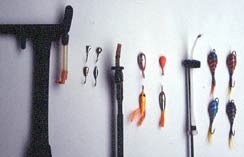
There are dozens of different shaped mormuskas. At present when the colours are as plentiful as one may hope, there are actually too many to choose from. The basic type is the drop-shaped morri, which gets strikes in almost any circumstances. You need a selection of colours because the striking colour is determined - once again - by the waterway, the season, the time of day and the weather conditions. You should have at least shiny, golden, leaden gray, black and red mormuskas in your morri purse if you want to see them in the jaws of big perch. You can bait the mormuska with either a fly grub or a chironomid grub. The latter are to be used as lures when the perch aren´t too eager to strike.
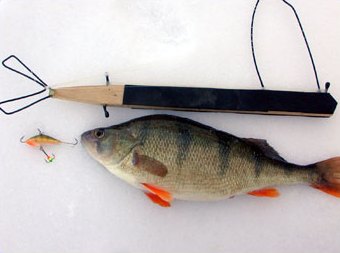
The tip of the mormuska rod is an important strike indicator. The fisherman has to follow both the vibes of the tip and the movement of the line in the drill-hole. That´s why the hole must be free of crushed ice. The fishing technique of the mormuska is simple but requires practise in the proper handwriting. You first lower the morri down to the bottom. When it reaches the bottom, the line goes slack. Next you start lifting slowly (some 20 to 50 cm) and spice the lift with vibrations. The purpose of this is that the perch see the morri as a small water insect which to them is a tasty morsel. You can also give an additional rhytm to the vibrations by gently tapping the root of the rod with your forefinger. The tournament icefishermen lower and raise the rig five times at each hole at the most. If there are no signs of fish by then, it´s time to drill a new hole.
BALANCED JIGS
The balanced jig is the wobble of the winter fisherman. You tie the balanced jig to the line when you want to catch the big perch that eat mostly smallfish. Because Finland is the native country of balanced jig fishing, we have numerous lure manufacturers making them. Rapala, Nils Master and Kuusamon Uistin are the manufacturers making the greatest numbers of balanced jigs. But just as it is with wobbles, balanced jigs are also made in dozens of small shops concentrating in jigs made specifically for use in local water areas. Jigs between two and seven centimetres in length are the most suitable for icefishing perch. The smallest balanced minijigs are effective when the bite is not at its very best and also the small individuals of the perch school strike at them. When you fish for the larger open sea and shoal perch, you can tie a bigger balanced to the line.
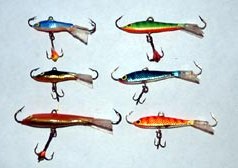
The good size is generally between four and five centimetres. You can also change the belly hook into a coloured one or else you can bait it, just see to it that the swimming movement of the jig is not disturbed. The swimming motion of balanced jigs is controlled either by a swimming plate or a hairy tail in the back. Both types of tail fish well if the jigs swimming is allright by all other accounts. The front and back hooks must be in line, the angle of the ring has to be right and the belly hook should be just the right size. Selection of colour will naturally depend on the water, weather e.t.c.
Fishing with the balanced you use a stiff-tipped rod to make the jig swim the right way and to preserve the contact with the jig the whole time.The drill hole has to be clean of crushed ice. When fishing you first lower the jig down to the bottom. With a brisk ca. 20 cm wrist jerk you give jig its initial speed. When the hand and the rod stay still, you can follow the jigs swimming motion in the water by the movement of the line at the surface. When the movement stops you give the jig a new jerk. Also when the movement has nearly stopped, a light vibration might be just the last lure to trigger the strike. The balanced jig is not only efficient near the bottom, suspended perch may strike at one just as well if you hang the balanced some way off the bottom. The right kind of handwriting is the secret of a successful balanced jig fisherman. Tournament icefishermen practise their handwriting in open water, those most eager for practise do it in buckets, bathtubs and even in the pools of swimming halls.